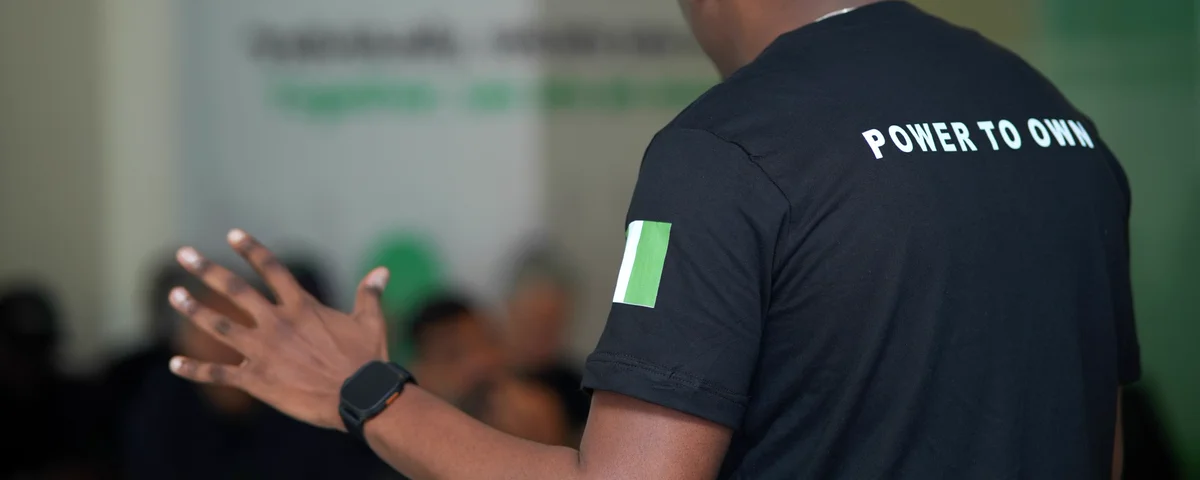
There is a version of Sunday evening I remember very clearly.
The shower would be running. I would be standing under it. And I would be crying quietly, deliberately, making sure the sound of the water covered everything so my wife wouldn't see how completely undone I was by the job I was going to return to in the morning.
That is not a metaphor. That is a real memory. A real job. A real Sunday evening, repeated more times than I want to count.
And then Monday would come.
I would put on my jacket. Walk into that office. And I would own my role. Completely. No half-measures, no passive resistance, no quiet performance of the minimum that would have been entirely understandable given the circumstances. I showed up the same way I always showed up with the same standard, the same attention, the same commitment to delivering excellent work.
Not because the environment deserved it. It didn't.
Because I had decided that my standards were not a function of my environment.
That decision made in private, under duress, with no audience is what eventually got me to Andela. Not a connection. Not perfect timing. A track record of excellence built in a place that made excellence genuinely difficult. And when the opportunity came, the evidence was already there.
That is ownership. And it is the most important professional decision I have ever made.
What Ownership Actually Is
Before I go further, I want to be precise because the word is used loosely enough that it has started to mean nothing.
Ownership is not passion. It is not enthusiasm or a burning sense of purpose or loving what you do. Those are wonderful when they exist. They are not ownership.
Ownership is the decision to hold yourself to a standard regardless of whether the conditions invite it. It means that when something is in your hands a task, a project, a team, a relationship you treat the outcome as personally yours. You ask what excellent looks like. You go find out. And you take responsibility for the gap between where things are and where they should be.
True ownership involves taking responsibility for outcomes, proposing solutions, and accepting accountability. Not just the parts you like. Not just the visible parts. The whole thing including the parts no one will ever notice if you skip them.
This is harder than it sounds. Especially when the environment is working against you.
High Agency: Moving Before Conditions Are Ready
I grew up watching my mother navigate her local business with limited resources, limited support, and no guarantee that the next day would be easier than the one before it. What I observed and absorbed without fully naming it at the time was a kind of agency that didn't wait for conditions to improve before it moved.
Nobody was coming to save her. So she didn't wait to be saved. She worked with what she had, in the direction she needed to go, and she figured out the rest as she went.
I carry that. It is the most foundational thing I own.
High agency, the way I define it, is the ability to move past "why me?" and immediately ask "what's next?" It is the refusal to let the absence of ideal conditions become the reason nothing happens.
If you don't have mentors, books and podcasts become your university. If you don't have capital, you start exactly where you are and build the credibility that attracts capital later. Constraints are not walls. They are puzzles. The only question is whether you are the kind of person who sits down in front of a puzzle and starts working, or the kind who waits for someone to solve it first.
The professionals I have seen stall genuinely talented people who never quite broke through were almost always waiting. Waiting for the right manager, the right role, the right environment, the right funding round, the right moment. And the moment never arrived, because the moment never arrives on its own. You build it.
The Basket of Skills
I did not follow a straight line.
Computer engineering at university. Data entry clerk at Phillips Consulting as an intern. A pivot to human resources at Access Bank. Community manager at Andela. Country Director at SafeBoda. General Manager at M-KOPA Nigeria and now Managing Director.
If you try to read a clear through-line into that sequence, you will struggle. And for a long time, I was not sure whether that was a weakness or a strength.
It is a strength. But I had to learn to see it that way.
When I was first rejected by Andela, I did not accept the rejection as the final answer. I went back. And I made a case for myself that no one else could have made, because no one else had my exact combination: engineering logic, recruitment strategy, and community engagement built across three different contexts. That basket of skills did not fit neatly into any existing role description. But I argued that it was precisely what the role needed and I was right.
The lesson I draw from that is not to never specialise. Deep expertise matters enormously. But if you build that expertise inside only one context, only one industry, only one type of problem, you lose something important: the ability to look at a complex business challenge and see it from an angle that the specialists cannot.
The operators I have most respected throughout my career are not the ones who mastered a single function. They are the ones who crossed enough disciplines to see connections that other people missed. That cross-disciplinary vision is not an accident. It is what you get when you treat each new environment as an opportunity to add to your basket rather than a distraction from your path.
Do not box yourself into rigid career scripts. The standard career path is designed for standard outcomes. If you want something different, you will need to build a profile that looks different and be confident enough to argue for its value when the room doesn't immediately see it.
The Shower Problem and the Social Media Myth
I want to come back to the shower. Because there is a conversation happening online that I think is genuinely harmful, and I want to be direct about it.
There is a strain of content that has become popular phrases like "I don't dream of labour," posts that celebrate doing the minimum, that frame genuine professional commitment as a form of exploitation. And I understand where it comes from. There are exploitative work environments. There are leaders who take credit for work they didn't do. The relationship between effort and reward is sometimes genuinely, structurally unfair.
But the argument the content makes that the response to a difficult environment is to reduce your standard, is the most expensive advice you can take. Because the person it damages most is you.
I was miserable in that job. Genuinely, shower-on-a-Sunday-evening miserable. And I still showed up on Monday and delivered. Not because the company deserved my best. Not because I had resolved the situation or was at peace with it. But because I had understood something that took me years to be able to articulate:
Your performance in a difficult environment is the evidence that gets you out of it.
The exit from a bad situation is almost never a direct confrontation with the situation. It is the track record you build while you are in it; the proof that you can operate at a high level under adverse conditions that eventually opens the door to something better.
If you lower your standard in protest, you destroy the evidence. You might feel righteous about it. But you make yourself harder to promote, harder to recommend, harder to bet on.
Use the difficult environment to build resilience. Learn what bad leadership looks like up close so you never replicate it. Sweat the details that nobody else cares about because your relationship with the details is what makes you excellent. And when the door opens and it opens because you earned it, not because you waited for it you walk through it ready.
Salary Is Not the Death of a Dream
At Founders Connect Live, Bayo Adedeji said something I want to repeat because it needs to be said more widely in our ecosystem:
"Salary is not what they pay you to forget your dreams."
There is a narrative in the African business community that positions the founder as the protagonist and everyone else as supporting cast. That if you are not building something of your own raising venture capital, issuing equity, sitting at the cap table you are somehow playing a smaller game.
I reject that narrative. Not because I am against founders, I spend my career helping founders build what they are building. But because it misrepresents what is actually possible in an operator's career, and it creates a false choice that holds talented people back.
Building a career as a high-performing executive operator is genuinely valuable. Financially rewarding. Professionally fulfilling. And — this is the part people underestimate, deeply impactful. The execution of a vision, the actual conversion of an idea into a company that serves millions of customers, happens through operators. Through people who choose to own someone else's vision as fully as if it were their own.
That is not a lesser version of ambition. It is a different expression of it.
What I and my team have built at M-KOPA Nigeria — a market from a standing start, a customer base now contributing more than half of the company's net new growth —was built with other operators like myself. Not as a founder. Not with my own equity at risk in the way a founder's is. But with the same level of ownership, the same commitment to the outcome, the same standard applied every single day.
You do not have to found a company to leave something behind that matters. You have to own the work in front of you completely. And that is available to everyone.
What the Business Cards Taught Me
My first professional job involved data entry and collecting business cards.
That was the job. Nobody dressed it up. Nobody told me it was building toward something. It was just the work.
I did it like it mattered. Because to me, it did.
Every business card, I paid attention to. The name, the company, the title, the context in which I collected it. Every row of data, I entered carefully and checked. Not because someone was watching. Not because there was a prize for precision. But because I had already decided that whatever was in front of me was going to get my full attention, regardless of its apparent importance.
Those habits; attention to detail, the discipline of doing unremarkable things thoroughly, the practice of caring about small things — are in me now. They show up when I am reviewing a financial model late at night, when I am giving feedback on a piece of communication, when I am in a negotiation and the precise meaning of a clause matters. I did not develop those habits in a high-stakes moment. I developed them in the low-stakes moments, the boring moments, the moments nobody celebrated.
That is how expertise is actually built. Not in the moments that demand it. In the moments that don't.
The unglamorous tasks lay the groundwork for everything that comes after. The business cards compound into a network. The data entry compounds into a way of thinking about information. The Sunday evenings compound into a resilience that, when you really need it, is already there.
What Ownership Produces
Let me close with what ownership has actually produced in my life not as inspiration, but as evidence.
It got me out of a job that was breaking me, into Andela, where I found a community and a way of thinking about talent that changed how I see organisations.
It got me from Andela into SafeBoda, where I was handed an entire market to build from nothing, in a city that wasn't Lagos, with a team that had never done this before.
At SafeBoda, the thing I am most proud of is not the 5,000 drivers or the 1.5 million rides. It is that when I left, my replacement came from inside the organisation. Naother person who reported to me is the Nigerian Country Director of a company digitizing Tax. We had built people, not just a business. And that only happens when the culture is one of ownership where people treat the outcomes as theirs even when the equity is not.
And it got me to M-KOPA Nigeria, where we have built past a million customers, past two million, and now contribute the majority of the company's net new growth.
None of that was planned in a five-year roadmap. All of it was prepared for in the accumulation of choices to show up when it was hard, to own the details when nobody was watching, to treat the present role like it mattered rather than like a waiting room for the next one.
Ownership is not a hack. It is not a trick you use to get ahead. It is a standard you hold yourself to consistently, privately, regardless of conditions until the standard becomes who you are.
And then the opportunities come to find that person.
Babajide Duroshola is the Managing Director of M-KOPA Nigeria. He was named Lagos State Technology Person of the Year 2024. He previously built SafeBoda Nigeria from the ground up as Country Director. He writes about leadership, strategy, and building in Africa.